

What is Gov School?
- Jennifer Moyers
- Feb 6, 2024
- 7 min read

by Rebeka Shulgan and Molly Walsh
Massanutten Regional Governor’s School for Environmental Science and Technology is one of Virginia’s 19 governor’s schools. Operating in the halls of Shenandoah County’s Mountain View High School, students are selected to attend from four surrounding public school districts; Page county, Rockingham County, Shenandoah County, and Harrisonburg City. Students at MRGS are from the top 10 percent of their class. They must be highly motivated to explore the interaction between humans and environmental systems, displaying strength in problem-solving, extensive research, investigation, and creative thinking.
College-Level Education
Every core class that is offered at Gov School can be dual enrolled and meets the requirements to take AP tests. This makes it easy for students to graduate high school with a 1-year certificate or an Associate’s degree. This is a wonderful opportunity because it allows students to get the same knowledge and credits that they would in college at a fraction of the cost.
Classes at Gov School
The MRGS curriculum is focused on real-world applications of the class topics. In order to provide context for class content, many major projects are collaborations of multiple classes. This can make the materials more interesting for students because it is easier to see why subjects are taught. As opposed to focusing on typical notes and tests, MRGS is a project-based institution. Some projects are individual, but most require some form of collaboration. Field work is something that is implemented by MRGS often. This year, the junior class has taken multiple trips to the river to test water quality, and even visited Food Lion to look into the origins of produce found there. Overall, learning in Gov School feels like learning about the world, not just memorizing enough to pass a test.

Research
One of the biggest things that makes gov school unique is the focus on independent research and exploration. Students at MRGS are required to choose a topic that intrigues them and conduct a one-to-two year long research project. Every Friday is set aside as a research day for students to work on current assignments for research, beginning with annotated bibliographies, a methodology, and a research proposal. After a student has completed their proposal, they can begin to conduct the objectives of their research project. The topics that students choose to focus on for their projects range between art, architecture, engineering, microbiology, astronomy, and much more. Students can choose to work under a mentor, and most decide to work with professors from local universities. Due to the variety in the topics students choose to cover in their projects, projects that initially were projected to last one year can be extended into their senior year. For larger projects that may take more than two years, seniors can choose to work with juniors and pass the project over to them post graduation. As new seniors, those students would be able to add the upcoming juniors to the research project and continue the work.
Junior Year
English - English class during junior year of Governor’s School consists of two college-level classes from Laurel Ridge taught synchronously by Jennifer Moyers; College Composition 1 (ENG 111) and Technical/Professional Writing (ENG 113). Students can also choose to take the AP English Language and Composition exam at their home school to receive the college credit through their score. These dual enrolled English courses are centered around technical writing, as this skill is greatly beneficial to the other courses offered at MRGS, and is especially helpful for the planning and analysis portions of students’ research projects. There are not too many assigned books to read in this course, and when there are, generous timing is given to read and analyze the book to complete assignments in response to what the students have read. Essays and writing assignments given to students are planned out to help students succeed on current or upcoming assignments in their other classes, showing the beauty of collaboration that Gov School takes advantage of.
Statistics - At MRGS, students take Statistics in their junior year, which, as with the other courses, students can choose to dual enroll and take the AP test if offered at their home school. There are two semester-long courses that make up this class, MTH 245 and MTH 246, both taught by Mrs. Katherine Klus. Unlike traditional math courses, there are no exams and tests in this class, and students receive grades on smaller assignments, such as practice sets, and on projects including lab reports and presentations. Students rarely receive direct lessons or lectures in this class; instead, the focus is on active learning and acquiring the knowledge and skills as they work on projects and assignments on the concepts they were introduced to, with teacher guidance along the way.

Agro-ecology - The first of the two junior year science classes is Agro-Ecology (AGR 142), which is taught by Mrs. Bates. Like the rest of the courses at MRGS, it is a college-level class that can be dual enrolled. This course focuses on environmental management, particularly regarding the field of agriculture. Much of the class discussion revolves around applying knowledge and skills learned in previous classes in real-world situations. For example, the class talked about best management practices for dairy farms and used that information to redesign a farm in an ecologically conscious way. Putting chemistry and biology into context can make the information more interesting and understandable.

Environmental Science/Geology - The second of the junior year science classes is Environmental Science and Geology (GEOL 105), which is taught by Mr. Kohrs. This class focuses on using geological structures to show environmental changes through time. It combines archaeology with biology and chemistry. This class also frequently requires the use of statistics to make predictions using information that students gather. One example of this was the Biometrics project which prompted students to create equations that should allow them to reconstruct an ancient hominid based solely on its footprints. This required students to gather measurements of their own bodies and find the correlation between them. This course implements the use of creativity to make ancient scenes feel personal. This includes everything from pliocene paleoart to instagram accounts run by early humans. It is a challenging and rewarding course.

NEW COURSE ALERT!! Student Development - To assist students desiring to obtain a one-year certificate or Associate's degree along with their high school diploma through Virginia’s Community Colleges, a new course will be offered through Governor’s School during the spring semester of junior year. This course is called Student Development 100 (SDV 100) and is required by colleges. This course is designed to test students’ college preparedness and skills such as money management, database research, career goals and planning, creating an academic plan, stress management, and maintaining a healthy lifestyle. This course is normally taught through assignments and assessments in modules, which many students struggle with as it is difficult to assess these skills through traditional teaching methods. Massanutten Regional Governor’s School takes on a different approach for this course, however, assessing the required skills skills throughout students’ other classes at Gov School, and supplementing for anything not covered on dedicated days throughout the second semester.
Senior Year
English/Humanities - Mrs.Moyers’s English class in senior year takes a slight turn from the prior year, with the two synchronous courses being American Literature (ENG 246) and Creative Thinking (HUM 246). Like the other courses, students can choose to dual enroll in these courses, and the creative thinking course goes to colleges as a humanities credit. According to a class of 2024 senior, Pria Dua, English class in senior year is different from junior year. Seniors work on applying technical writing skills from ENG 111 & 113 to interpret classic literature, poetry, and “..analyzing elements of plot and theme to other relevant areas of our life. For example, we just finished reading Frankenstein, and have been discussing implications of modern technology and taking science too far” (P. Dua, personal communication, December 7, 2023).
Geology - One of the two science courses taken by seniors is geology (Geology 110- Earth Systems). This class focuses on the geological processes that shape the earth. Students use this knowledge to understand the world around them as it is today, but also as it was millions of years ago. This class often intersects with calculus. Pria Dua, an MRGS senior, described this by saying, “..we use basic derivative rules, slope functions, and integrals in Mr. Kohrs’ class when dealing with large data sets.” This class involves using small pieces of history, such as individual rocks, to reconstruct a bigger story. It is a study in science and problem solving.
Agricultural Policy - At MRGS, seniors take Agricultural Policy (Ag Policy 241), which is taught by Mrs. Bates. This course builds on what students learn in their junior year Agro-Ecology class about creating and implementing viable systems that can improve the ecological impact of agricultural production. This course involves leaning into the legal side of conservation and the ways in which one can convince people to do what is best for the environment. Another topic that is discussed is the ethics of science and how to recognise when testing is going too far. This was wisely intertwined with discussions about the novel Frankenstein. Although the title of the course may lead to the belief that it is all about farming, this class covers a wide variety of information.
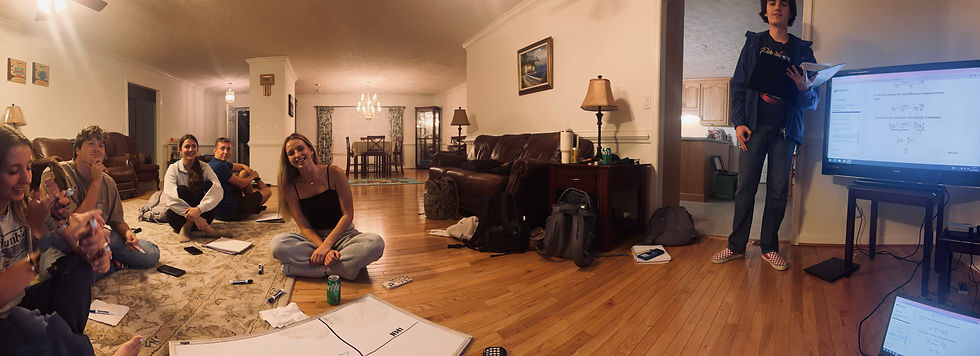
Calculus - As seniors, students at MRGS take Calculus 1 and 2 (MTH 263 and 264) for their math course and credits. These two college level courses are likely one of the more challenging to take on in one year. Pria Dua stated that “the first overarching theme we learned in calculus was the principle that there are infinitely many solutions. During that first week, we all thought our stress levels would be ‘infinitely many’ as well. However, as we’ve progressed we have learned a lot in calculus and had a lot of fun” (P. Dua, personal communication, December 7, 2023). The rigor of this course, however, allows the students to bond and work through it together, with the help of Mrs.Klus. When it comes to exams, or more favorably named “chances to excel,” current seniors meet up to study and spend time together, bringing them together and helping them succeed! (P. Dua, personal communication, December 7, 2023).

Whole School Projects/Collaboration - Governor’s School offers many collaborative opportunities across not only entire classes, but across the whole school with all senior and junior classes. To kick off each school year, seniors and juniors are placed in groups to collaborate on a project designed to test student’s creative thinking skills. This allows new juniors to acquire skills required for success in Gov School and life, including presentation skills, citation, and unique responses to challenges. Research classes are also made up of a mix of the junior and senior classes, depending on the topic of students’ research projects. This allows students to socialize with people who have similar interests to theirs, as well as get good peer feedback on assignments.
Resources
Dua, P. N., (October 14, 2023). A group of seniors gathered outside of school to study for their calculus exam [panorama photograph].
Dua, P. N., (October 14, 2023). Senior Graham Roulston working on a calculus problem on Delta Math before the seniors’ calculus midterm [photograph].
Massanutten Regional Governor’s School. Facebook (2013). https://www.facebook.com/massanuttengovschool?mibextid=LQQJ4d


Comments